BUY & HOLD good companies you understand

I want to illustrate the power of buying and holding. As Warren Buffett says, “our favorite holding period is forever.”

I also want to talk about buying household names that you know and understand. This idea that you can invest in companies whose products and services you use every day is something popularized by Peter Lynch, who is one of the most successful investors of our time (he managed the Fidelity Magellan Fund to an average annual return of 29.2%, making it the best-performing mutual fund in the world at the time). His philosophy was “invest in what you know,” and it’s actually very similar to the idea of investing within your “circle of competence,” which was popularized by Warren Buffett. 

Onto my illustration… Microsoft and Meta (formerly Facebook) reported their quarterly results yesterday. Those results were very good for both companies, and so their stock prices jumped during the next trading day (Microsoft was up ~4% and Meta was up ~12% at some point during the day). 

Well, roughly 13 years ago, as a regular happy user of the products of both companies, I happened to purchase some shares in both of these companies (15 shares of Microsoft and 25 shares in Meta). I also happened to hold these shares and not sell them. As the time went by, Microsoft’s share price increased and it paid out a quarterly dividend, which I automatically re-invested right back into the company. Same happened with Meta, though it only started paying a dividend in 2024. 

When I bought Microsoft stock, the shares were priced at $30.76, so I paid a total of $461.35 for the 15 shares. Today, those same Microsoft shares are valued at ~$536 per share and $8K for the 15 shares (up 1,642%). If I include dividends, my Microsoft shares are valued at around $10K. Note that the dividends also grew at high rates.

Meta stock cost $20.28, so I paid $507 for the 25 shares. Today, Meta shares are valued at ~$778 per share and ~$19.5K for the 25 shares (up 3,737%). If I include dividends, my Meta shares are valued at around $19.6K.

Both companies are in the technology space, which is known for high growth. However, Microsoft is a 50 year old company (founded in 1975) and Meta is a 21 year old company (founded in 2004). Though I bought Meta in the year it went public, I bought Microsoft about 26 years after it went public. I wasn’t an early investor in either of these companies. Though I didn’t make retirement money there, I think it’s intellectually exciting to be able to generate a gain of 1,600%+ in a 50 year old company 26 years after its IPO. 

This is how a few winners can make up for some duds. 

Of course, the market has been very hot and some of these gains are driven by the overall stock market performance. That said, these companies have executed really well, managing existing core business and staying on top of innovation. A lot of people at these companies contributed to this success, but the leaders at the top play a critical role (CEO Satya Nadella at Microsoft and CEO Mark Zuckerberg at Meta).

Thank you, Satya and Mark. Best wishes for the next 12 years. 

The point? Well run companies of any age with great leaders and solid business models can produce very exciting results with a bit of patience.

P.S. Don’t forget to automatically re-invest the dividend.

Disclaimer: none of this is investment advice. Please do your own homework and invest carefully and thoughtfully.

Exhibit A: Microsoft transactions (includes some but not all dividend transactions)
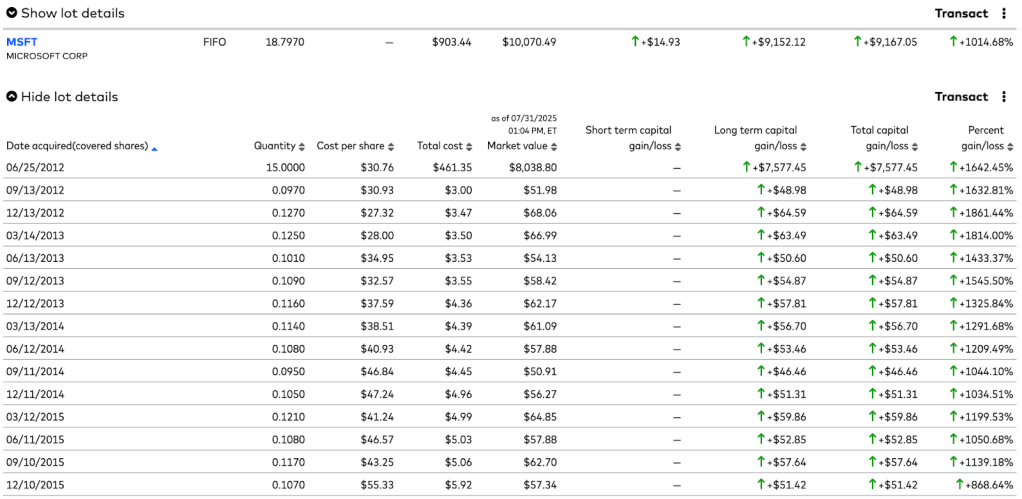
This is a sample of Microsoft share transactions, including dividends re-investments. Not all years of dividends are included here. 

Exhibit B: Meta transactions

These are Meta transactions, including dividends re-investments.

Books can have sky high ROI, so read (or listen)

At the end of 2019, I bought a book on Audible for 1 credit (each credit costs me $14.95 in my Audible subscription plan). The book was called A Simple Path to Wealth by JL Collins. I listened to it on my annual Personal Offsite as I took time to reflect on the past year and to get energized for the year (and years) ahead. 

The simple takeaway from this book reinforced what I was already doing: buying Vanguard index funds. However, JL narrowed it down even further. He famously suggested one specific index fund – VTSAX (Vanguard Total US Stock Market Index). His recommendation was a bit more nuanced than this and he suggested some other index funds as bubble wrap around this anchor tenant of a portfolio, but he made a solid argument for this financial product (it provides exposure beyond the US because US companies do a lot of business internationally; it is self cleansing, which means underperforming stocks naturally come out of the index and get replaced by new better performing stocks; etc.).

To make the long story short, three months after finishing the book, I started to follow the simple and crystal clear advice of dripping cash into VTSAX. As of this writing, after about five years of dollar cost averaging into this index fund, my paper gain is substantial and enough to buy me and my family a few years of memorable vacations (a double digit annual return in terms of %). Of course, that has a lot to do with the fact that the US stock market has performed well over that time (3/2020 to 7/2025), despite the pandemic. However, had I not listened to the book, I would not have done this. Of course, until I sell this fund, the gain is just on paper, but I will let it compound for a while longer. It is a very diversified fund, with ~3.5K US public companies in the index. By the way, the ETF version of this fund on Vanguard is VTI. VTI is basically the same thing as VTSAX and has some additional advantages like higher liquidity. 

As with everything, this is not financial advice. VTSAX could easily go down 50% as the market has done a few times in the past. It is also not an endorsement of doing whatever one reads in a book. What I am hoping this illustrates is that books can hold extremely valuable ideas that can be super powerful when met with action. So, keep on reading and keep on investing. 

A bonus action I took as a result of reading that book is starting this blog (JL started a blog before writing his first book: http://www.jlcollinsnh.com). Thanks, JL. 

Get kids started early

I was reading Kiplinger and saw a reference to an app that helps parents to introduce kids to saving and investing. This app is called Greenlight and it allows you to send your child or children money to be used for various use cases: spending, saving, investing, and allowance.

It’s probably most useful for older children because one of the key features of the app is a debit card. However, I set it up for my 7-year old to get him exposed to some key personal finance concepts early.

I got him a debit card with his face on it for security and fun. The debit card he will use when he goes to the bookstore or toy store with me or other family members.

I was also very excited to get him to finally buy some stocks. We’ve been talking about buying shares of companies for a while and he’s been getting excited to become an owner. Finally, Greenlight was an easy way to get him going, without having to open some formal brokerage account.

Essentially, I took some money that he received for his birthday and sent it to his Greenlight account. Then, the fun began. He had $100 to work with and he really wanted to invest in companies that he believes are doing well. According to him, the companies he sees him or grownups using a lot are probably doing well and could grow in share price. For a basic analysis, that was good enough for me. That’s how he chose Disney and Apple, both very popular stocks in the app. I then guided him to also get some VOO (S&P 500 Vanguard ETF) to diversify his risk a bit and to have him be an owner of a lot of companies all at once. He really liked that idea.

At first he wanted to only invest $1 or $5 dollars into each stock, but I got him to really develop some conviction about his positions and he leaned in with $20 each. So, he invested $60 into the stock market and kept $40 in his Savings account.

As soon as he invested, the stock market took a hit, so he experienced that part of investing when you see your holdings go down in value. I was a bit bummed at first because I wanted him to really get excited about growth and investing. However, I felt it was good and real for him to also experience the downturn and to display some discipline to not sell. After a few days watching his stocks going down, he was definitely antsy to sell, but he held strong.

On the other hand, his Savings account gets 1% interest, so he also gained $0.02, which was small but nice to experience. Parents can increase this interest out of their pocket if they want the lesson of interest and compounding to be more clearly learned.

There are so many possibilities to explore and lessons to teach through this app, or a similar app. I get excited about thinking what results he might be able to see if he keeps investing small amounts into ETFs, such as VOO, and holds it for decades. Compounding makes young age so much more powerful than meets the eye.

The table below is from The Money Guy Show, one of my favorite podcasts on YouTube. In the table, you can see just how powerful age can be. For example, my son starting at age 7 has a ~394 money multiplier, which means his money will grow roughly that much from this age onwards without any additional contributions. That means that his invested ~$60 could turn into $23.6K by the time he is 65 years old. It also shows that if he puts away ~$26/month from now going forward, he will be a millionaire by the age of 65. It gets much harder to grow money when you start later; it’s obvious, but I hope this serves as a good visual reminder.

Note that there is a monthly subscription fee to get access to the app. I think it’s totally worth it to teach life-long lessons, but it will only make sense if he continues to be interested.

Disclaimer: If you click on my Greenlight link above and signup, we both get $30. All proceeds go to my son’s account and I recommend you do the same.

Investing in education (529 plans)

Books are cheap but education is priceless.

I enjoy investing and ever since I came to live in a capitalist country, I’ve been hooked. That said, even when I lived in a communist country, I knew that the most important investment one could make is in education. Education can set you up not only for a more lucrative career, but also for a more informed and interesting life. My parents invested everything they had in my education and I benefited from that investment mightily. So, as soon as my kids received their social security numbers, soon after birth, I set up their 529 plans.

I looked at different options (e.g. custodial accounts, etc.), but ultimately thought that setting up a Vanguard 529 plan was the simplest and best thing to do. Basically, you can put away money that can only be used for education related expenses, but if you use that for education expenses, you don’t have to pay federal taxes on the gains from those investments (some states also give you a tax break). So, if you plan to pay for education at some point and you believe that investing money will produce better financial results than keeping it under your mattress, this could be something for you to consider.

For a married couple, you can automate your plan to add $2,500 per child per month, without hitting the gift tax (this number could change year to year). Whatever the amount you choose, I recommend automating it so that you are constantly investing in the future and don’t let human nature get in the way.

You have to be careful to not over invest because these funds can only be used for education, although they don’t have to be used for the originally intended recipient (you can change to another child or to a grandchild, yourself, etc).

The way I look at it: Education costs are not going away and they will probably only increase. Moreover, you can now use these funds to pay for kindergarten and up (not just college expenses), so it may make sense to put away more than you originally thought if you plan to send your kids to a private school.

A nice advantage of the 529 plans over some other education savings options is that the owner of the account maintains control and can move the money to someone else at any point. That means the beneficiary can’t just go and spend this money on whatever they want. Also, and probably because of this, this type of account doesn’t reflect as poorly on financial aid applications as some other options that make the money look more like they belong to the student asking for financial aid (e.g. grandparents opening up a savings account in the name of their grandchild is worse for financial aid purposes).

The only question in my mind is whether to begin to take some of this money out when kids are in elementary school, etc. on one hand, I want the money to keep growing and compounding for college years. On the other hand, K-12 now costs per year close to what college costs (in the San Francisco Bay Area), so it might be helpful to leverage some of this money earlier than college. Ultimately, I think it depends on your specific financial situation and how much money you need during the K-12 years.